My Research
Overview
My astrophysics work primarily involves the discovery of new stars—typically binary systems—that teach us something new about what phenomena are possible in space.
I primarily use multiwavelength crossmatching between X-rays from the SRG/eROSITA mission and optical data from the Zwicky Transient Facility (ZTF) and Gaia. I also draw on data from Chandra, Keck, and the VLA. I am broadly interested in applying statistical techniques to extract scientific results from large astronomical datasets, and have shown that a simple tool—the “X-ray Main Sequence”—can efficiently reveal the true demographics of accreting white dwarfs in the solar neighborhood.
A New Class of Radio-Pulsing Sources: Long Period Radio Transients
Long period radio transients (LPTs) are the first new class of radio pulsars in decades. While traditional pulsars and millisecond pulsars occupy the sub-second period regime, LPTs exhibit radio pulse periods on the order of minutes to hours—an entirely unexplored region of parameter space.
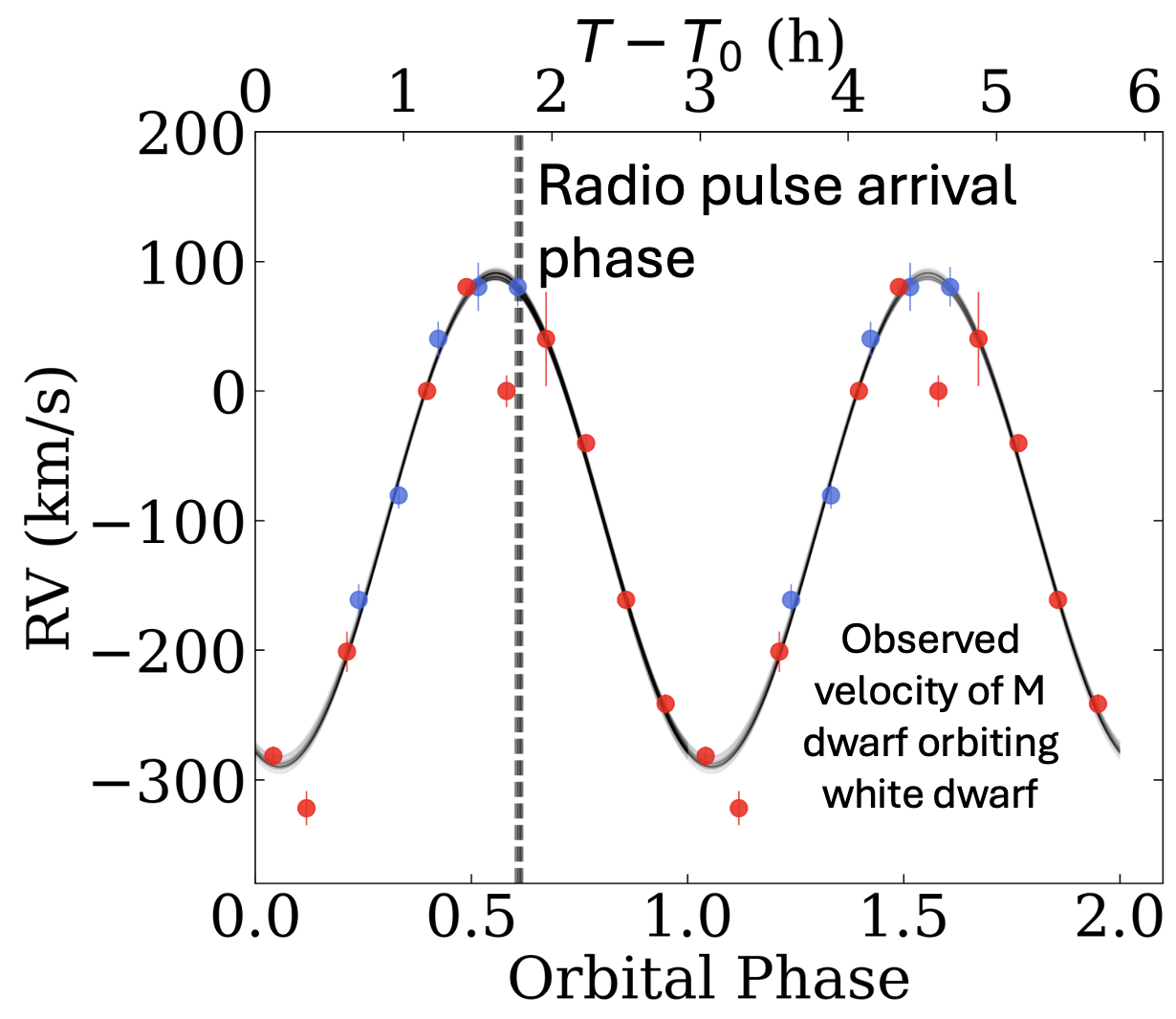
My work demonstrated through optical spectroscopy that one newly discovered LPT is actually a binary system consisting of an M dwarf orbiting a white dwarf—providing a key constraint on the physical mechanism behind this mysterious class of sources.
Accreting White Dwarfs (Cataclysmic Variables)
Cataclysmic variables (CVs) are binary systems in which a white dwarf accretes material from a companion star, producing powerful X-ray and optical emission. I identify and characterize magnetic CVs—polars and intermediate polars—by combining eROSITA X-ray data with optical photometry from ZTF and spectroscopy from Keck.
My discoveries in this area include new eclipsing CVs, period-bouncer systems (where mass transfer has reduced the donor to brown-dwarf mass), and magnetic white dwarfs caught in rare accretion episodes. A central result from this work is the X-ray Main Sequence: a classification diagram that maps accreting white dwarfs in X-ray/optical color space, enabling demographic studies of CVs across the solar neighborhood.
Ultracompact White Dwarfs and Gravitational Waves (AM CVn Binaries)
AM CVn binaries are the most compact known stellar systems, with orbital periods of just 5–65 minutes. In these systems a helium-rich donor—typically a semi-degenerate white dwarf—transfers mass to an accreting white dwarf, continuously emitting millihertz gravitational waves. They are among the strongest expected sources for the future LISA space gravitational-wave observatory.
I have discovered eclipsing AM CVn systems that yield precise measurements of component masses and orbital parameters. These measurements help build the statistical sample of verified gravitational-wave emitters needed to test models of ultracompact binary formation and evolution.
Stellar-Mass Black Holes
Most stellar-mass black holes in the Milky Way formed through the collapse of massive stars and remain entirely silent—no accretion disk, no pulsations, no detectable electromagnetic signature. My work uses eROSITA and ZTF to search for dormant and weakly-accreting black holes in the solar neighborhood. By combining sensitive X-ray upper limits with optical variability constraints, I characterize the prevalence of quiescent black holes and compare the results to predictions from stellar evolution models and binary population synthesis.
Gravitational Microlensing
Gravitational microlensing occurs when a massive foreground object magnifies the light of a background star through gravity—regardless of whether the foreground object emits any light of its own. This makes microlensing one of the only tools capable of detecting dark compact remnants such as isolated black holes, neutron stars, and brown dwarfs in the Milky Way. I analyze ZTF’s high-cadence, wide-field survey data to identify and characterize microlensing events, with a focus on long-timescale events that point to compact-object lenses.
FU Ori Objects: The Most Powerful Young Stars
FU Ori objects are young, pre-main-sequence stars undergoing dramatic accretion outbursts, brightening by several magnitudes over timescales of months and remaining luminous for years to decades. These events are thought to drive much of the total mass accretion during a star’s formation. I developed AccDiskSpec, a Bayesian spectral-fitting framework for modeling the multi-wavelength spectra of FU Ori accretion disks. This enables precise measurements of mass accretion rates and disk temperatures during these rare and powerful eruptions (Rodriguez et al. 2022).